I was meeting with a client of mine, and we were discussing a new product line he was planning to introduce.
It was an interesting conversation. The product line would be different from his current lines.
The actual products had not yet been completely determined or created, and there was no real pricing concept behind them.
But there was already a clear expectation.
The new line would add substantial revenue to the business and be highly profitable.
I was intrigued.
So I asked him a simple question:
How do you plan to position it in the market-place?
He spent the next several minutes explaining why the price—although we did not actually know what that price would be yet—would give the product a great position in the market.
That is when I realized we needed to start from scratch.
We were not really talking about the same thing. Price and Positioning are not the same thing.
I needed to shift the conversation to pricing strategy.
A Price Does Not Only Generate Revenue
Let us take something as ordinary as toothpaste.
Suppose we decide to introduce a new toothpaste at $ 3.49.
That is the Retail Price.
You wonder what I mean: Ahhhh—There is the Manufacturer Price, then the Wholesaler Price, the Distributor Price and the Retailer Price.I will explain later, but back to my example:
The moment we put $ 3.49 on that tube, we have done much more than determine how much the customer will pay.
We have begun to determine where that product belongs in the market-place and, most importantly, on the Shelf.
Put it on a shelf and it will naturally find itself surrounded by other toothpastes selling somewhere around that price range. Those products will become its competitive environment.
By the way, I said “somewhere around that price range,” because usually one competes with products within 10% +/- of its price on the shelf or in the market.
But something else has happened too.
We have begun to define which companies we are going to compete against.
I am often asked: How come? Really Simple: Price determines Positioning and Positioning determines Price. They are inseparable.
We are no longer simply asking whether $ 3.49 covers our fixed/variable costs and gives us our desired profit.
We are asking whether our product can successfully compete in the market-place that $ 3.49 has helped us choose.
What are our competitors offering?
What features and benefits do their products provide?
What does their packaging communicate?
How are they promoted?
Where are they sold?
What does the customer believe those brands represent?
Why do customers relate to these brands?
And perhaps most importantly:
What value are we giving the customer for $ 3.49?
If we are going to occupy that position, we need to offer the customer comparable value—or give them a reason to believe we are offering something better.
That Is Where Positioning Comes In
Positioning is not simply deciding whether we want to be an inexpensive, mid-priced or premium product.
It is part of the pricing strategy itself.
Price helps establish the competitive space in which the product—and ultimately the company—will operate.
And once we enter that space, all the other pieces have to support it.
The product has to make sense at that price. The packaging has to stand out and have its own personality—Packaging with attitude. The distribution has to make sense. The promotion has to not only make sense but talk clearly to its consumers.
Some of you may recognize some old friends here:
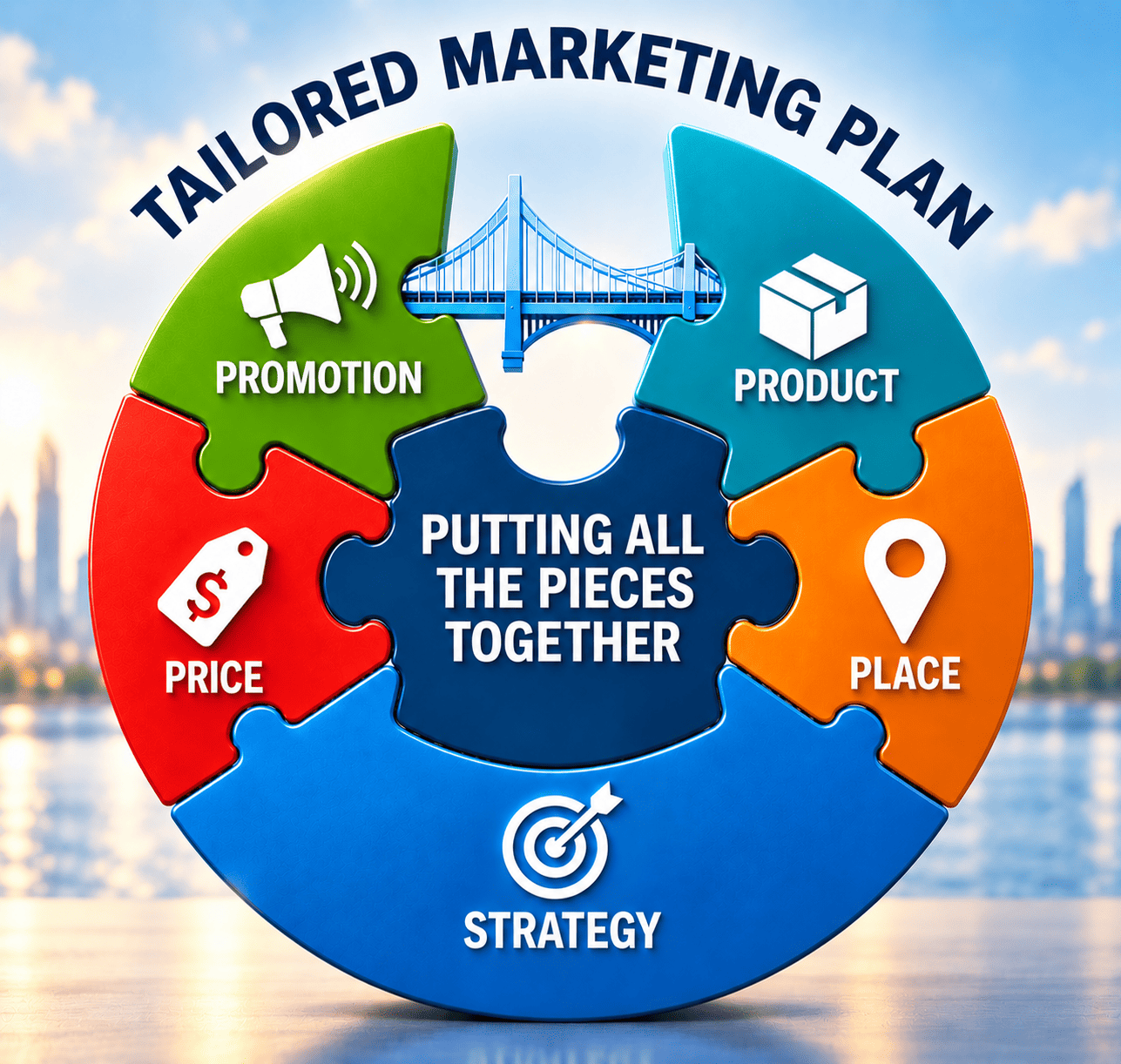
Product—Place—Promotion—Price.
Our Friendly 4 Ps.
They have been around for a long time, but perhaps we sometimes forget why they belong together.
Change one, and you may affect the others.
Which Brings Me to Discount Stores
Over the years, I have developed a somewhat unusual way of looking at discount stores.
“Discount stores are mistakes of Marketing.”
That may sound harsh or blunt at first.
But walk through one and look at the merchandise there and ask yourself:
Why are these brands selling here?
Many of those products were not originally conceived, developed, packaged and produced with the intention of ending up there.
Somewhere along the way, something went wrong.
The logic is very simple:
Wrong Product — wrong features, design, packaging, quality, quantities, or value for the intended customer.
Wrong Price — the market did not accept the product at the price and position originally provided.
Wrong Place — the distribution strategy put the product in the wrong channels, locations, or markets, or the product was rejected by the intended channels or markets.
Wrong Promotion — the message may have been inadequate, or the advertising, timing, or promotional support failed to create the expected demand.
This is not that complicated. One P can be wrong, several can be wrong, or the four simply may not work together. The result is failure in the market-place.
The discount store is not necessarily where the mistake was made.
It is where we can see the result.
And that is one of the reasons I find pricing so interesting.
A price may look like a number printed on a package, a shelf or an invoice.
But behind that number are decisions about the customer, competition, positioning, value, profitability and ultimately the direction of the business.
So the next time you see $ 3.49, do not just look at the number.
Take a look at what is sitting next to it.
You may be looking at the company’s strategy.
The Question Becomes: How Does Pricing Work?
I can write a book about Pricing, as I have done that Globally for Companies. I want to explain my previous statement: “There is the Manufacturer Price, then the Wholesaler Price, the Distributor Price and the Retailer Price.”
So the customer told me: “What do you mean, my price and their price? I never heard of such a thing. I set my price, and that is it.”
I explained to him that in order to address Growth, it was essential to work with the Distribution Channel on Pricing as follows:
*** Wholesaler Price: Allow a certain margin for them to properly promote the line.
*** Distributor Price: Slightly more complicated, as they handle the distribution for you—the Place of the 4 Ps—and require more attention and support.
*** Retailer Price: Most challenging for you, as they need promotional programs and advertising for your product line. Most of your Promotion cost is right here.
I added: “This is your Team. You either run the show or they go rogue. Strategy, Strategy, Strategy.”
Price is another piece. Positioning is another piece of the puzzle.
I told him afterwards: “We put all the pieces together for you.”
Then I smiled and said, “You understand my pieces better now.”
He laughed.
There is one more piece here. Price applies to both Products and Services, and the Distribution Channel applies to both, although it varies depending on the industry.
I wish I had a simple formula for you; however, the golden rule is simple: What is the role of Price?
Of course, the role of Price is to make you a profit.
But in order to do that, “The Price has to cover the Cost of the Product/Service, Cost of Place/Distribution, Cost of Promotion, and Cost of Price.”
That brings us to the starting point: Price Is Not Just a Number. Before picking a number, deciding on a number, studying a number and researching it, first develop a Pricing Strategy that is inclusive of the core concepts we discussed.
Often, I tell my students, “If you want to learn about Marketing, visit discount stores.”
The lesson for them to learn is why these products/companies end up in there. In most cases, as they say, “It is the Price, Sherlock.”
What We Do at PPI
We Put All the Pieces Together for You
Contact us to start the conversation.