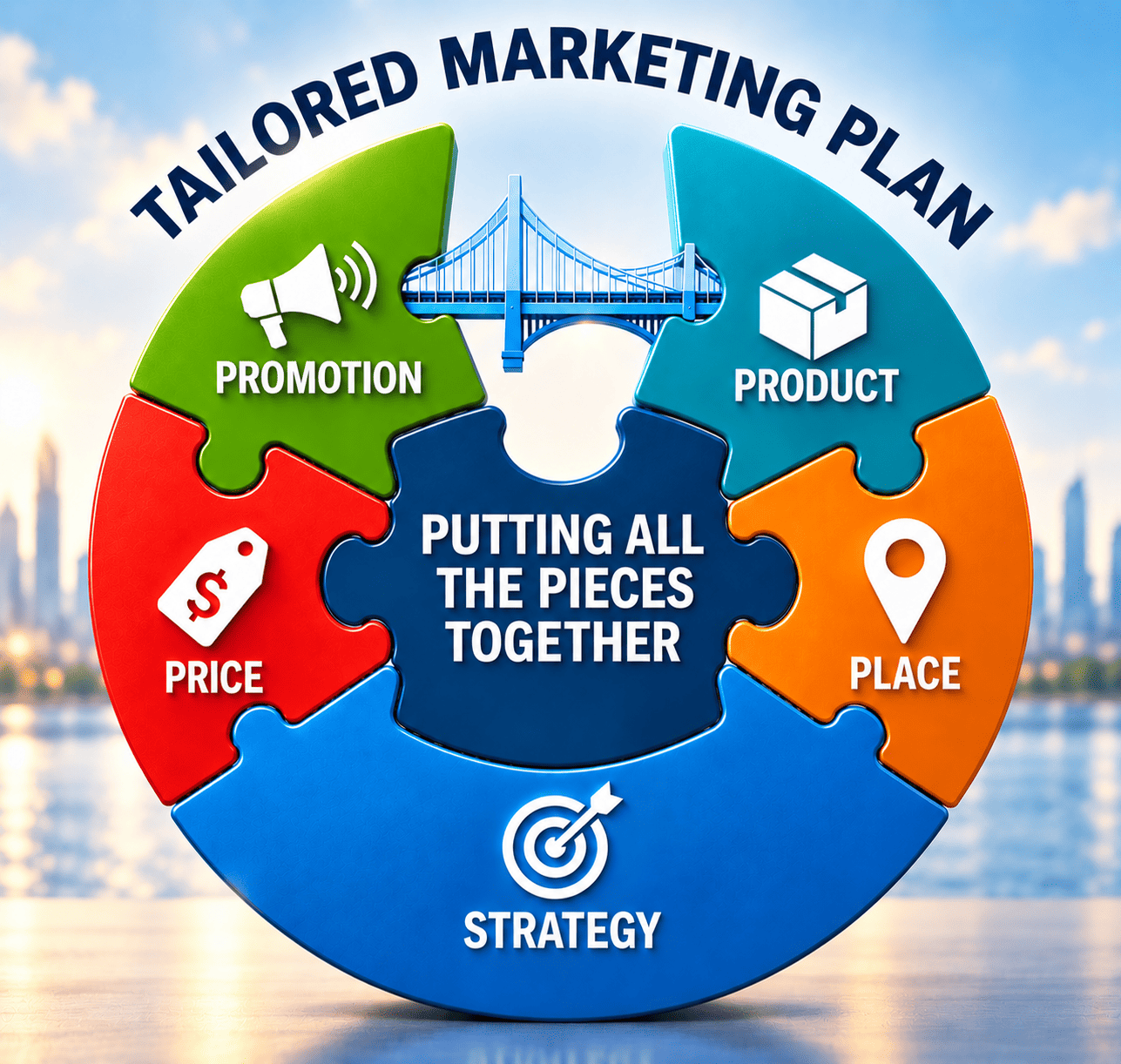
The importance of Pieces
In my second year, on one of my trips, I met with a new client and showed him a line of shower curtains. That line became one of my best-selling lines, and it was born as a result of a new piece
I had added: market research.
I had started asking buyers a very simple question: What are you missing in the market? What product lines are European companies short on?
To my surprise, the answer in several countries was shower curtains.
It reinforced something I was learning very early: listen to your customers. They can tell you what they need, what is missing, and how their markets really work.
During my meeting, the owner insisted on borrowing my shower-curtain samples for the evening. Yes, I used to carry actual samples of the product lines I represented. They were an important piece of both the puzzle and the gift box.
I told him I needed the samples the next morning for other meetings and couldn’t give them away. He promised to return them at breakfast.
The owner asking to take my samples home was a small detail. But it was very unusual— there was nothing standard about it. I was tempted to simply say yes and move on. Instead, his odd behavior made me want to know why.
So I told him I would trust him with the samples if he told me why he needed to take them home.
His answer was revealing:
“I have to show them to my wife. She knows what customers buy.”
Here was the owner of the company, the person I considered the decision maker, telling me that someone I had never met had an important influence on what he bought.
That meeting taught me another lesson about perception. Perception is an acquired skill. I had to work at it and develop it over time— paying attention to details in meetings, behavior, reactions, what was being said, what wasn’t being said, while still keeping sight of the overall picture.
That unusual request for my samples revealed another piece of the puzzle: identify and research who really influences the buying decision. It may not always be the CEO or the buyer.
To put the pieces together, I had to learn how to see the pieces in the first place.
Let Me Clarify One Thing
The gift box has to be created before starting the business.
The packaging has to be orchestrated prior to opening the doors.
The puzzle has to be put together at the start as well.
Really understanding who you are.
Naturally, the system will be improved and adjusted as it is implemented.
It is not stagnant. Neither is the gift box.
Business Systems Creation
Building a system is not about creating procedures for the sake of having them. It is about knowing what happens throughout the business.
What happens after an employee receives an inquiry or order? Who follows up? What happens next? What happens when something goes wrong? Does everyone know the next step? Or does each person simply handle things their own way?
These were questions I had to answer as I built my business.
I needed systems that connected the different pieces—from finding customers, researching markets, selling and presenting product lines, receiving orders and placing them with the company, to follow-up, collections, letters of credit, shipping and monitoring.
Each piece had its own life and entity.
But they could not operate in a vacuum. They had to connect, complement and support each other while still performing their individual roles.
And things went wrong. There had to be a system for that too—for me, my team and the outside service providers we relied upon.
That is why we build systems.
Making the Pieces Work Together
Creating the systems was great in theory. However, making all the pieces work together was quite a challenge.
What could go wrong? Banks created challenges, that is what they did. Service providers encountered problems they could not always fix, they relied on us to resolve them.
Sometimes the ball came back to me. More serious issues had to be dealt with individually as they had no standard solutions.
I also learned the importance of knowing what we controlled and what we did not. The customer needed to know the difference between the services we provided and were responsible for and those we facilitated through outside providers.

I Was the Bridge
My fees were substantially higher than my competitors because of the value of the additional services we delivered.
Getting the order was an accomplishment, but our role was far from over. We followed the transaction from processing to collecting payment, documentation, shipping and delivery overseas. Whenever problems took place in the process, they usually came back to us.
When the customer paid the company, we made sure the order was processed immediately.
When the company owed the customer money because of a short shipment for example, we followed through to make sure the customer received what was owed.
Neither the company nor the customer lost a penny in the process. Both were protected by us.
Something became very clear. There was a link between the company and the customer that went far beyond selling the product. It involved trust, money, solutions and ultimately delivery.
I was that link. I was the bridge.
I was the link that held both sides together and serviced both sides at the same time.
That was another important piece of the identity of the business—and part of the Gift Box that kept on giving.
Partners Were Pieces of Growth
The standard in the industry was to travel to a market, find a customer, get an order and pass it along to the company represented. The service could essentially end there.
I saw the role differently.
I researched the markets and compared our products and prices with European competitors. Customers sometimes told me our prices were too high, but I needed to know if that was actually true. I had to sometimes work the numbers backward to estimate where European competitors were selling.
Without that comparison, I would have been going into the market blind.
I presented the lines and developed the customers. Why? Because I was building for long-term growth. So getting the order was only one part of the service.
The order had to be processed. Payment had to be collected. Letters of Credit had to be negotiated and presented. Documentation had to be prepared. The goods had to be shipped and monitored. We helped make it easier for the companies to sell internationally—and easier for the overseas customer to buy from them.
I didn’t perform every service myself. I was not the bank, the freight forwarder or the shipping company.
But I worked with them and added their capabilities into the services we provided.
A partner became a structural piece of our own puzzle.
As customer needs expanded, so did the pieces. We added warehousing and consolidation through outside partners. We helped customers find other product lines and manufacturers. Some pieces were ours. Others were provided by partners we worked with. What mattered was what we were ultimately able to deliver.
Before I expanded the business, I expanded what the business could deliver.
Then Came Growth
The first phase of growth was geographic. I started exporting into one region and then expanded the model into others. Naturally, expansion did not always mean duplication. Different markets sometimes required different approaches. As the business expanded, new systems and pieces had to be created alongside the existing ones.
Then came Private Label—a completely different form of growth. We moved from selling existing product lines to developing lines for customers, from packaging and product development through manufacturing and delivery. Such a new service meant new partnerships, new pieces and new systems.
Next came Importing. Before starting PPI, I had worked for both an export and then an import company. This experience led me to a rule I still believe in: Do not Import if you do not know how to Export.
Importing meant helping foreign companies enter the U.S. market. Their products and packaging might need to be adapted. Pricing had to be structured for the U.S. market. The right distribution channels had to be identified and the promotional strategy tailored to the right consumer. The puzzle had many pieces that had to work together before successfully entering the market.
The next growth phase was Marketing Consulting, Export/Import Consulting and Sourcing. Again, some pieces could be transferred, others modified, and new ones added. Growth was no longer simply about expanding the business. It was about creating the right partnerships for expansion and building the right skills necessary for growth.
The Art of Putting All the Pieces Together
Creating the pieces was only part of it. They had to be given their own purpose and personality. And then they had to interact and work with each other.
I sometimes think of it as conducting an orchestra. The notes may all be there on paper, nicely organized, but that doesn’t bring the music to life. Each instrument has its own sound and personality. The art comes when all those instruments work together and the music comes to life.
The business puzzle is not a static entity. It evolves with the business. Pieces are added, others change, and the puzzle itself can take on a completely different shape.
It is not a perfect square or rectangle. It is a painting.
Systems are essential, but they have to adapt to an ever-changing environment. Creativity is sometimes the solution when things go wrong. It is also the path to growth and innovation.
The Orchestra at Work
You are probably wondering by now: What are all these pieces he keeps talking about? What does art have to do with business?
Nice stories, interesting concepts, but as they say, “Where’s the beef?”
I like to keep things simple. Art is a big part of business. That is why packaging sells products. Look at cosmetics and perfumes, where enormous attention and investment go into creating packaging that is attractive, distinctive and designed to convince the consumer to buy.
That is art.
The way you package your business is just as important. How you present your company, your products, your services and the value you deliver becomes part of what the customer is buying.
Simple and true.
All my pieces are part of the orchestra. Each has its own purpose and personality, but they are essential to how the whole business performs.
Putting the Pieces Together is not simply a nice quotation. It is at the foundation of what we do. We build the right foundation for a business to flourish and grow—a foundation strong enough to withstand turmoil, change and evolution.
So, what do all these pieces really mean?
Packaging created the promise. It embodied the identity and how the business presented itself.
The Gift Box delivered the value. It was everything the customer ultimately received
The Puzzle brought all the pieces together. Each piece had its own personality, but its real value came from interacting with the others.
The Systems gave the pieces structure and life.
The Bridge created trust and continuity between the business and its customers.
Partners became structural pieces of the puzzle. They expanded what the business could deliver.
Growth added new pieces, expanded existing ones and changed the shape of what the business could become.
Where is my orchestra? What happened to the painting? Fascinating concepts.
Keeping it simple has been the rule, so these pieces above are the core components, and each has a large following to constitute the puzzle.
The orchestra is at work when all these different elements are created, defined, outlined clearly, given their purpose, and shared with the team.
Next, the canvas is laid out, and the masterpiece is created. That painting symbolizes what we want to convey in the marketplace and how the orchestra will deliver that fine-tuned outcome—identity, products and services, culture and more. They are all connected, and thinking about putting the bigger picture together is what leads to the role of the orchestra.
It can only deliver a masterpiece that will live in the future.
The point here is simple: creativity and innovation are what drive businesses. They are at the foundation of business success, and they exist only because of art and passion.
The journey does not stop at your one masterpiece.
As the business grows, new pieces are added, systems and opportunities are created. Then comes a new generation of paintings, and a new family is born.
Passion, Creativity and Innovation have to be incorporated into all the pieces of the Puzzle
and Gift Box.
When you open the doors for your business, the pieces are in place, the Gift Box is full, the
Puzzle is envisioned, the Systems are created, and your Marketing Plan with its five-year financial projections sets the path for growth and success.
The orchestra is in harmony. The foundation is in place. Your path is in your hands.
What We Do at PPI
We Put All the Pieces Together for You
Contact us to start the conversation.