Here is something I found rather shocking.
A 2025 Enji study surveyed 245 U.S. small-business owners across 40 states and 13 industries. https://www.enji.co/state-of-small-business-report-2025
Less than 25% had a documented Marketing Plan.
Think about that for a moment.
More than 75% may be running their businesses without a documented Marketing Plan.
But there was another finding that caught my attention.
Businesses with a documented Marketing Plan were three times more likely to “always” or “usually” complete their planned marketing activities.
Those are some pretty shocking statistics.
Most companies know what a Marketing Plan is. It is a Plan of Action.
Some prepare one because a bank asks for it. Others prepare one for an investor, a new product, or perhaps because someone told them they should have one.
But that raises a much more important question:
What do you actually do with it?
A Marketing Plan is not simply a report.
It is a blueprint for implementation.
And perhaps one of the simplest places to begin is with some old friends:
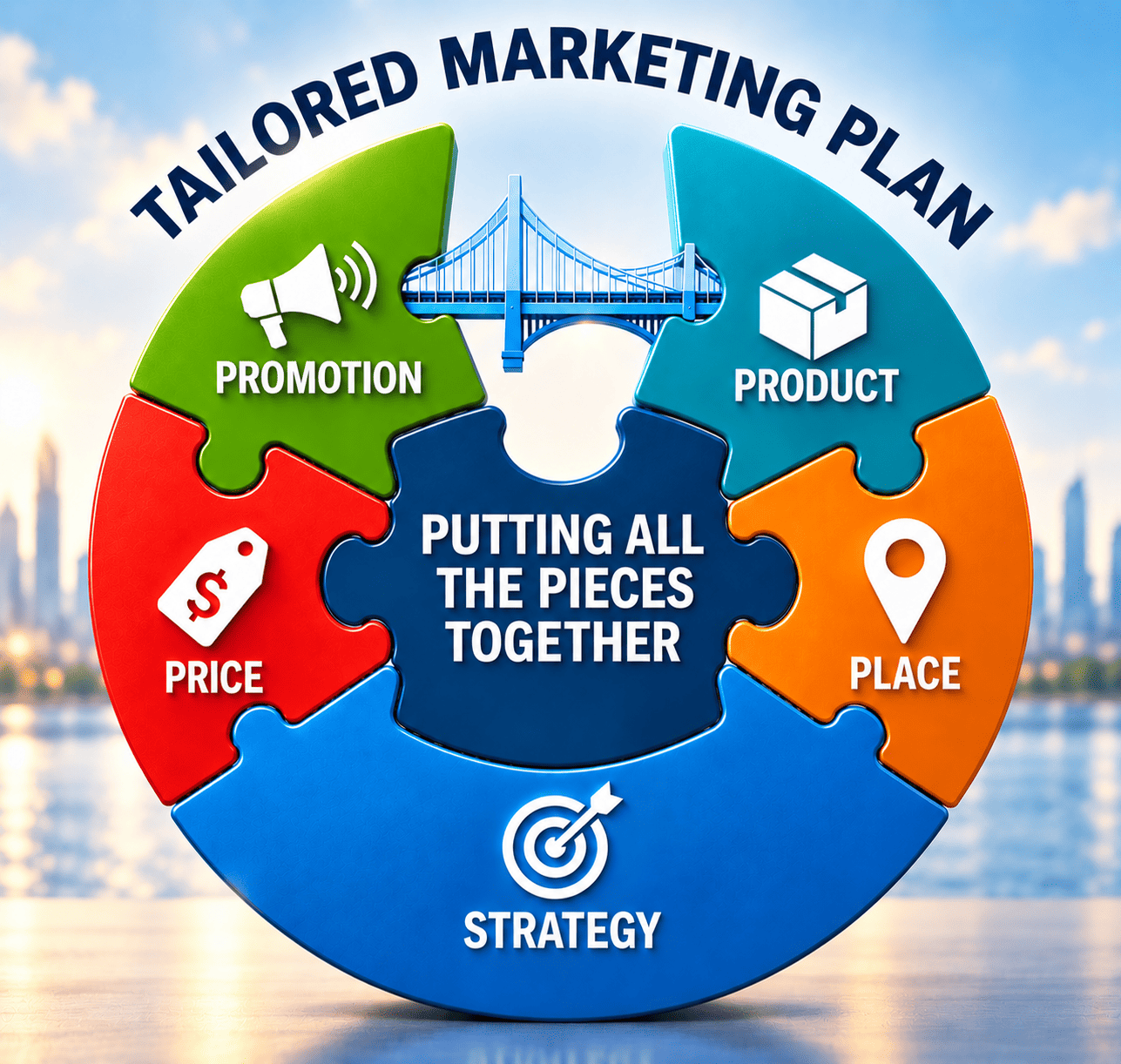
The 4 Ps—Product — Place — Promotion — Price.
They sound great and impressive.
But do you really know your 4 Ps?
More importantly, does your Sales Team?
Do they know how to promote the features and benefits of your Product or Service?
Can your salespeople spit them out instantly during a presentation?
Do they know the competition and how your offering differs?
Do they improvise and make things up?
Have they lived with the product or even used it?
I mean that literally.
When I traveled internationally, I sometimes lived with my samples for six weeks—day and night. I knew those samples inside and out. I knew their features, their benefits, their strengths, their weaknesses, how they compared with the competition, and what they represented.
I used the products at home to see how they performed. I promoted the superstar that sold the line. The product had to perform, and if I believed in it, I sold it to the buyer—and the buyer sold it to the customer.
I performed market research for the companies I represented, and that research became part of my Marketing Pl
Because after a while, those samples were not simply products.
They represented the livelihood of the company.
And that is where the Marketing Plan comes in.
Your Sales Team should not have to invent the answers. The Marketing Plan should provide them with the knowledge, direction and clarity they need to implement what the company is trying to accomplish.
The Marketing Plan should be their sacred document for implementation.
The Marketing Plan is based on real life. It is not a stagnant object sitting on the floor or a table.
It generates your revenues and shines the path to growth, innovation and success.
Companies that do not have a Marketing Plan have a team that lacks desire, drive, vision and clarity. They simply want to achieve numbers that have no valid foundation.
Numbers do not promote the identity and culture of your business.
The Marketing Plan does.
And it does not stand still.
The Marketing Plan is assessed monthly or quarterly and updated annually.
Because the market does not stand still, neither should your Marketing Plan.
And here is something worth thinking about.
Perhaps the question is not simply:
Do you have a Marketing Plan?
Perhaps the real question is:
Does your company live it?
The Art of Putting the Pieces Together
If you are wondering what all these pieces have to do with a Marketing Plan, that is exactly the point. The Marketing Plan is where they are created, constructed, put together and come together. And Yes, all these are separate functions.
The outcome here is a live document, a piece of art, not a stagnant piece of paper.
So you have a glorious social event. You need a new outfit, a special suit or distinguished
fashionable dress. It has to be fitted to be a perfect fit, and then comes wearing it at the event and getting that recognition. That tailor is the artist; they bring their passion and drive for perfection so the implementation is flawless.
Wait, what does all this have to do with the Marketing Plan?
Very simple. The Marketing Plan creates the roadmap for implementation and coordinates with other departments to implement the strategy.
That Marketing Plan was for your party. It created a strategy to reach the end goal, and everything had to fit perfectly together, from the concept of your wardrobe, to the perfection in tailoring, to the artistic flair in the process and, most importantly, the implementation—Putting All the Pieces Together.
A lot could have gone wrong. Simply picking your outfit off the rack, ignoring the tailoring and its value, would have led to an embarrassing result socially. Following through with the implementation was essential.
I left out some pieces on purpose. Where do I buy from? How? Why? Research needed?
Guess who does all that, your Sales Team.
Marketing and Sales are often treated as separate functions. It is amazing that your
Marketing department creates new products, then imposes them on the salespeople, which is fairly common in the industry, and your Sales Team wonders, “Who thought of that?”
When these products do not sell because no one in Marketing asked Sales if such products are in demand, they end up in Discount Stores.
What a vicious circle.
When Marketing and Sales work together, success is inevitable. As simple as this.
Actually, I have done both. I did Sales and Marketing and learned the importance of them being a perfect twin.
Distribution is managed by Sales; they generate the revenues for Marketing and the business.
That outfit you bought, how did it get there?
Fascinating when you connect these pieces, and that is why in your plan, you start with a
Strategy that lays the foundation for the business. You dissect the 4 Ps in detail so that
Marketing and Sales know exactly what to do and how to coordinate together.
Marketing is useless without Sales, and Sales is useless without Marketing.
I know you are wondering by now, what do I do in a Marketing Plan? Have a seat.
The first step is to simplify the complexity. That Strategy I keep referring to represents the Identity, Culture, and Business Concept. The latter emanate from the business owners and/or management team. They are compiled through the deep discussions we have about who they are today, what they want to become and how they want to grow.
That sets the soul of the business from which we extract the foundation for our Marketing Plan.
The next step really is identifying the 4 Ps, and in most cases creating them, so that the Marketing department uses them as a stepping stone for implementation. The challenging P is Price, which needs a separate strategy that incorporates Positioning—figuring out where to sit in the market, who to compete against and how.
From the previous paragraph, we lay the plan for the Sales Team and engage them to work with the Marketing team.
I also tackle financial projections for 5 years. That sets realistic benchmarks for the team.
And there is another piece we sometimes forget: Creativity.
How can you be creative in a Marketing Plan? It is not a painting where you throw paint on the canvas.
Well, a Marketing Plan is not simply an exercise in analysis, research and numbers. It requires imagination—the ability to look at the pieces differently, connect them differently and sometimes create something unique that was not there before and fits only that business.
The tailor fits the outfit to you only, and I fit the Marketing Plan to the company only. No two alike.
In order for businesses to grow and have longevity, they need to generate sales and profits.
A Marketing Plan’s role is to show you how to generate these sales and secure profits as well.
What We Do at PPI
We Put All the Pieces Together for You
Contact us to start the conversation.